

Copper Nickel 90/10 vs 70/30
Jul. 02, 2026
In marine vessels, desalination plants, offshore platforms, and heat exchanger projects, choosing between Copper Nickel 90/10 and 70/30 is a common decision for procurement and engineering teams. Both are copper-nickel alloys with good resistance to seawater corrosion, but the choice is not simply a matter of “one is cheaper and the other is more expensive.”
If your project involves relatively low water velocity and a moderately corrosive environment, many engineers choose Copper Nickel 90/10 pipes. However, if the system operates continuously in high-velocity seawater, polluted seawater, or more demanding service conditions, Copper Nickel 70/30 tubes are generally the more reliable choice.
What Is Copper Nickel 90/10?
Copper Nickel 90/10 generally refers to C70600 / CuNi 90/10, with the following typical chemical composition:
- Copper (Cu): approximately 88.6%–90%
- Nickel (Ni): approximately 10%
- Iron (Fe): approximately 1%–1.8%
- Manganese (Mn): small amount
The addition of iron and manganese improves the alloy's resistance to erosion corrosion in flowing seawater. The greatest advantages of 90/10 copper nickel are its excellent cost-performance ratio, good weldability, and ease of fabrication. As a result, it is widely used for marine seawater piping, cooling water systems, fire protection pipelines, and general seawater heat exchangers.
If your project places greater emphasis on cost control, you may first explore matching solutions for Copper Nickel pipe fittings and piping systems. In most cases, the overall project budget is easier to manage with 90/10.
What Is Copper Nickel 70/30?
Copper Nickel 70/30 generally refers to C71500 / CuNi 70/30, with the following typical chemical composition:
- Copper (Cu): approximately 70%
- Nickel (Ni): approximately 30%
- Iron (Fe): approximately 0.4%–1%
- Manganese (Mn): approximately 0.5%–1%
Because 70/30 contains a significantly higher nickel content, it generally offers superior mechanical strength, erosion-corrosion resistance, and performance in high-velocity seawater compared with 90/10. It is commonly used for naval vessels, offshore platforms, power plant condensers, seawater desalination facilities, and high-performance heat exchanger tube bundles.
If your equipment will be exposed to polluted seawater, sand-laden seawater, or high-flow seawater over a long period, it is recommended to give priority to Copper Nickel 70/30 seamless tubes.
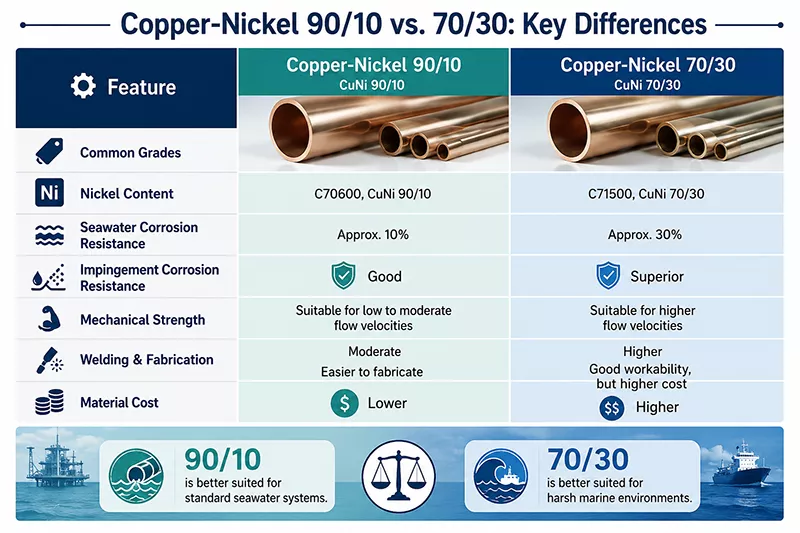
Copper Nickel 90/10 vs 70/30: Key Differences
| Item | Copper Nickel 90/10 | Copper Nickel 70/30 |
| Common Grade | C70600, CuNi 90/10 | C71500, CuNi 70/30 |
| Nickel Content | Approximately 10% | Approximately 30% |
| Seawater Corrosion Resistance | Good | Superior |
| Erosion Corrosion Resistance | Suitable for low to moderate flow velocities | Suitable for higher flow velocities |
| Mechanical Strength | Moderate | Higher |
| Welding & Fabrication | Easier to fabricate | Good fabricability, but at a higher material cost |
| Material Cost | Lower | Higher |
| Typical Applications | Marine piping, cooling water systems, general heat exchangers | Naval vessels, offshore platforms, high-velocity seawater systems, condensers |
90/10 is generally the preferred choice for conventional seawater systems, while 70/30 is better suited to demanding marine environments.
Corrosion Resistance: Is 70/30 Always Better Than 90/10?
In terms of material performance, Copper Nickel 70/30 generally provides better corrosion resistance than 90/10, especially in high-velocity seawater, polluted seawater, and demanding offshore environments.
However, not every project requires 70/30. Copper nickel alloys naturally form a stable protective oxide film in seawater, and this protective layer plays a critical role in their corrosion resistance. For standard marine seawater cooling systems, ballast water systems, and fire protection pipelines, 90/10 is fully capable of meeting the requirements of many engineering designs.
However, if any of the following conditions apply, 70/30 is generally the better choice:
- High seawater flow velocity
- Seawater containing sand or suspended solids
- High operating temperatures
- Frequent system start-up and shutdown
- Higher requirements for service life and safety margin
- Naval vessels, offshore platforms, or power plant condenser projects
Before selecting the alloy, it is recommended to evaluate the design pressure, flow velocity, medium composition, and applicable standards, while also confirming that the Copper Nickel material test certificate complies with the project specifications.
Mechanical Properties and Service Life
Due to its higher nickel content, 70/30 generally offers higher tensile strength and better fatigue resistance. This makes it a preferred choice for systems exposed to frequent vibration, significant pressure fluctuations, or demanding structural requirements.
The main advantages of 90/10 are its excellent ductility and workability. It is easier to bend, weld, and install on site. For large-scale piping systems, 90/10 not only reduces material costs but also improves installation efficiency.
In practical projects, many shipyards adopt a complete system consisting of 90/10 pipes + copper nickel flanges + copper nickel fittings. You can also refer to Copper Nickel Flanges to match the appropriate pressure class and applicable standards.
Cost Difference: Why Is 70/30 More Expensive?
Copper Nickel 70/30 is generally more expensive than 90/10, mainly because of its higher nickel content. Fluctuations in nickel prices directly affect the cost of copper nickel pipes, plates, and fittings.
From a procurement perspective, the choice between 90/10 and 70/30 should not be based solely on the purchase price. Instead, the total life-cycle cost should be considered, including:
- Initial material cost
- Installation and fabrication cost
- Maintenance frequency
- Downtime risk
- Service life
- Replacement part cost
For standard seawater systems, Copper Nickel 90/10 is usually the more economical option. For critical equipment, difficult-to-maintain locations, or highly corrosive environments, the higher initial investment in 70/30 may significantly reduce long-term operational risk.
Copper Nickel 90/10 vs 70/30: Which One Should You Choose?
When to Choose Copper Nickel 90/10
Copper Nickel 90/10 is generally the right choice for the following applications:
- Commercial ship seawater piping systems
- Marine cooling water systems
- Firefighting water systems
- Ballast water pipelines
- Standard seawater heat exchangers
- Ports and coastal engineering projects with low to moderate corrosion environments
Copper Nickel 90/10 is widely recognized for its proven performance, reliability, and cost-effectiveness. It has become the standard material for many conventional marine piping systems.
When to Choose Copper Nickel 70/30
Copper Nickel 70/30 is recommended for projects involving the following service conditions:
- Naval vessels
- Offshore oil and gas platforms
- High-velocity seawater cooling systems
- Power plant condensers
- Seawater desalination equipment
- Polluted seawater or sand-laden seawater environments
- High-reliability heat exchanger tube bundles
Copper Nickel 70/30 is better suited for projects where maintenance is difficult, downtime is unacceptable, or corrosion conditions are especially severe.
Standards and Specifications
Common standards for copper nickel pipes and fittings include:
- ASTM B466: Seamless Copper Nickel Pipe
- ASTM B467: Welded Copper Nickel Pipe
- ASTM B111: Copper Nickel Tubes for Condensers and Heat Exchangers
- EEMUA 144 / 234: Common specifications for marine and offshore copper nickel piping systems
- DIN / EN / JIS and other project-specific standards
When requesting a quotation, avoid simply specifying "CuNi pipe" or "Copper Nickel tube." Instead, clearly define:
- Material grade: C70600 or C71500
- Standard: ASTM B466 / B111 / EEMUA 144 / 234, etc.
- Dimensions: OD, wall thickness (WT), and length
- Temper: Annealed, hard-drawn, or project-specified condition
- Inspection requirements: Hydrostatic test, Eddy Current Test, PMI, UT, and MTC
- Matching components: Flanges, elbows, tees, and reducers
If you are preparing an RFQ, you can also refer to the standard size range available for Copper Nickel Pipes and Tubes.
Final Recommendation: Copper Nickel 90/10 or 70/30?
Copper Nickel 90/10 is suitable for most conventional seawater systems, while Copper Nickel 70/30 is the preferred choice for more demanding marine environments requiring higher flow resistance, superior corrosion resistance, and greater reliability.
In practice, you can make your selection using the following guidelines:
- Looking to control costs with moderate service conditions: Choose Copper Nickel 90/10
- High flow velocity, severe corrosion, or long service life required: Choose Copper Nickel 70/30
- If the project specification already requires C70600 or C71500: Follow the specified standard
- If the service conditions are uncertain: Consult your supplier to evaluate the medium, temperature, pressure, and flow velocity before confirming the material grade
Selecting the right material from the beginning can significantly reduce future maintenance costs and minimize the risk of unexpected downtime. For seawater piping systems in particular, spending extra time to confirm the correct alloy grade is often far more cost-effective than replacing an entire pipeline after installation.
FAQ – Copper Nickel 90/10 vs 70/30
Which has better corrosion resistance, Copper Nickel 90/10 or 70/30?
Copper Nickel 70/30 offers superior corrosion resistance and better protection against impingement attack, making it ideal for high-velocity seawater and harsh marine environments. Copper Nickel 90/10 provides excellent corrosion resistance for most standard seawater piping and cooling systems at a lower cost.
Can Copper Nickel 90/10 be used in seawater applications?
Yes. Copper Nickel 90/10 is widely used for seawater cooling systems, ballast water piping, firewater systems, heat exchangers, and marine pipelines. It has a long history of reliable performance in seawater service.
Why is Copper Nickel 70/30 more expensive than 90/10?
The primary reason is its higher nickel content. Nickel is one of the most expensive alloying elements in copper-nickel alloys, so the increased nickel percentage significantly raises the material cost of 70/30.
Which alloy is easier to weld, Copper Nickel 90/10 or 70/30?
Both alloys offer excellent weldability. However, Copper Nickel 90/10 is generally easier and more economical to fabricate and install. Proper welding procedures and qualified filler materials should always be used to achieve optimal performance.
Which alloy is better for heat exchanger tubes?
Copper Nickel 90/10 is an economical choice for conventional seawater heat exchangers. For power plant condensers, desalination equipment, polluted seawater, or high-flow systems, Copper Nickel 70/30 is generally the preferred option because of its higher corrosion and erosion resistance.