

What Is ASTM B466 C70600 Pipe?
Jul. 02, 2026
ASTM B466 C70600 pipe is a seamless copper nickel pipe manufactured according to ASTM B466, a standard specification for seamless copper-nickel pipe and tube. The material grade C70600 is commonly known as 90/10 copper nickel, which means it contains approximately 90% copper and 10% nickel, with small additions of iron and manganese to improve corrosion resistance.
This pipe is widely used in seawater systems, shipbuilding, offshore platforms, desalination plants, condensers, heat exchangers, and marine piping networks. If your project requires long service life in saltwater or brackish water, ASTM B466 C70600 copper nickel pipe is often one of the most reliable options.
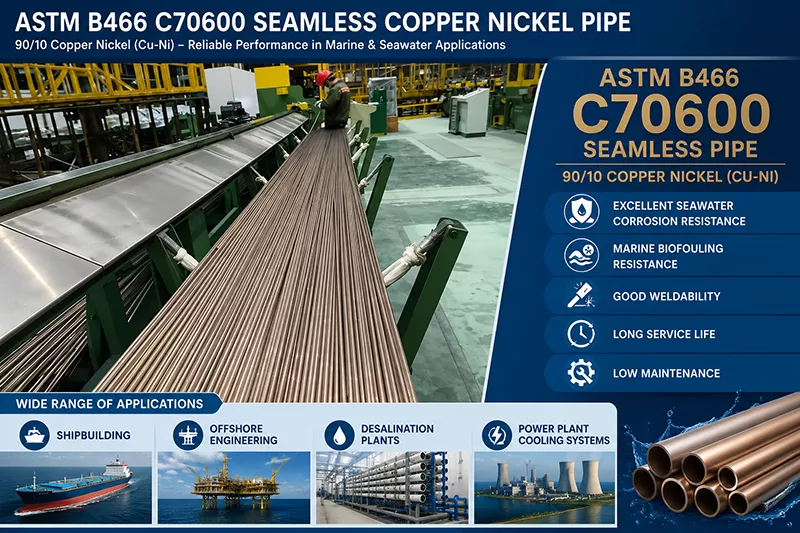
If you are selecting copper nickel pipe for a marine or industrial project, ASTM B466 C70600 is often a practical and cost-effective choice. For technical support, size confirmation, or quotation, you can contact our copper nickel pipe team with your project specifications.
ASTM B466 and C70600: What Do They Mean?
To understand ASTM B466 C70600 pipe, it helps to separate the standard from the material grade.
ASTM B466
ASTM B466 is the manufacturing standard. It defines the requirements for seamless copper-nickel pipe and tube, including chemical composition, mechanical properties, dimensions, tolerances, workmanship, testing, and inspection.
In simple terms, ASTM B466 tells the manufacturer how the pipe should be produced and tested.
C70600
C70600 is the UNS material designation for 90/10 copper nickel alloy. This alloy is valued for its excellent resistance to seawater corrosion, biofouling, stress corrosion cracking, and erosion corrosion.
Compared with ordinary copper or brass pipe, C70600 performs much better in marine environments. Compared with C71500 70/30 copper nickel pipe, C70600 is usually more economical while still offering excellent corrosion resistance for many seawater applications.
Chemical Composition of ASTM B466 C70600 Pipe
The typical chemical composition of C70600 copper nickel pipe is:
| Element | Content |
| Copper | Balance |
| Nickel + Cobalt | 9.0% – 11.0% |
| Iron | 1.0% – 1.8% |
| Manganese | Max 1.0% |
| Zinc | Max 1.0% |
| Lead | Max 0.05% |
| Other Elements | As specified by ASTM B466 |
The addition of iron is especially important. It helps the alloy form a stable protective surface film in flowing seawater, improving resistance to erosion and corrosion.
Key Properties of ASTM B466 C70600 Pipe
ASTM B466 C70600 pipe is selected for demanding marine service because it offers a balanced combination of corrosion resistance, strength, weldability, and durability.
Excellent Seawater Corrosion Resistance
C70600 copper nickel pipe performs well in clean seawater, polluted seawater, brackish water, and marine atmospheres. Once exposed to seawater, it develops a thin protective oxide film on the surface. This natural film helps protect the pipe from further corrosion.
Good Resistance to Biofouling
Marine organisms such as barnacles, algae, and mussels can attach to many piping materials. Copper nickel alloys naturally reduce biofouling, helping maintain flow efficiency and reducing maintenance costs.
Strong Resistance to Erosion Corrosion
In seawater piping systems, flow velocity matters. C70600 has good resistance to erosion corrosion under suitable design conditions, making it useful for shipboard seawater lines, firewater systems, and cooling water systems.
Easy Fabrication and Welding
ASTM B466 C70600 pipe can be welded, brazed, bent, and fabricated using proper procedures. This makes it suitable for complex piping layouts. For complete systems, it is often used together with copper nickel pipe fittings and copper nickel flanges.
Long Service Life
One reason engineers choose 90/10 copper nickel pipe is its long-term reliability. In properly designed systems, it can reduce shutdowns, leaks, and replacement costs compared with lower-grade materials.
Common Applications of ASTM B466 C70600 Pipe
ASTM B466 C70600 pipe is widely used across marine, offshore, and industrial sectors.
Typical applications include:
- Shipbuilding seawater piping systems
- Offshore platform cooling lines
- Firewater systems
- Ballast and bilge systems
- Desalination plants
- Heat exchangers and condensers
- Power plant cooling systems
- Hydraulic and pneumatic lines in marine environments
- Seawater intake and discharge lines
- LNG and FPSO vessel piping systems
For projects that require a complete piping package, many buyers source copper nickel pipe, fittings, and flanges from the same supplier to ensure material compatibility and documentation consistency.
ASTM B466 C70600 Pipe vs C71500 Pipe
Both C70600 and C71500 are copper nickel alloys, but they are used in slightly different service conditions.
| Item | C70600 | C71500 |
| Common Name | 90/10 Copper Nickel | 70/30 Copper Nickel |
| Nickel Content | About 10% | About 30% |
| Cost | More economical | Higher cost |
| Corrosion Resistance | Excellent | Superior in more severe conditions |
| Strength | Good | Higher |
| Typical Use | General seawater systems | Higher velocity or more aggressive seawater |
In many marine piping systems, ASTM B466 C70600 pipe is the preferred choice because it offers a strong balance between performance and cost. However, for more severe seawater conditions or higher design requirements, ASTM B466 C71500 pipe may be recommended.
Available Sizes and Forms
ASTM B466 C70600 pipe is commonly supplied in seamless form. Depending on the project requirements, it may be available in different outside diameters, wall thicknesses, lengths, and tempers.
Common supply options include:
- Seamless round pipe
- Seamless tube
- Straight lengths
- Cut-to-length pipe
- Annealed or drawn temper
- Custom wall thickness according to project drawings
Before ordering, buyers should confirm the required size, wall thickness, pressure rating, inspection standard, and certification documents.
If you need a specific size list, you can check our copper nickel pipe size chart or contact the sales team for project-based availability.
Testing and Inspection Requirements
ASTM B466 C70600 pipe is usually supplied with strict testing and inspection to ensure quality and compliance.
Common inspection items include:
- Chemical composition test
- Mechanical property test
- Dimensional inspection
- Visual inspection
- Eddy current test or hydrostatic test
- Surface quality inspection
- Material traceability review
For marine and offshore projects, additional third-party inspection may be required by classification societies such as ABS, BV, DNV, LR, or CCS.
When purchasing ASTM B466 C70600 pipe, always request an MTC, usually EN 10204 3.1 or 3.2, depending on the project specification.
How to Choose the Right ASTM B466 C70600 Pipe Supplier
Choosing the right supplier is as important as choosing the right material. A qualified supplier should understand ASTM standards, marine project requirements, and export documentation.
Before placing an order, check the following:
- Does the supplier provide ASTM B466 compliant material?
- Can they offer full material certificates?
- Are the pipes traceable by heat number or batch number?
- Can they supply matching fittings and flanges?
- Do they support third-party inspection?
- Can they handle custom sizes or urgent delivery?
For shipbuilding and offshore projects, it is often better to work with a supplier who can provide a complete copper nickel piping package, including pipe, elbows, tees, reducers, flanges, and welding consumables.
You can also visit our copper nickel pipe supplier to learn more about available grades and supply capabilities.
Why ASTM B466 C70600 Pipe Is Popular in Marine Systems
Marine piping systems operate in harsh conditions. Saltwater, oxygen, flow velocity, vibration, and temperature changes can quickly damage ordinary materials. ASTM B466 C70600 pipe is popular because it solves many of these problems at the same time.
It resists seawater corrosion, controls marine growth, handles flowing seawater, and offers good mechanical performance. That is why it has become a standard material for shipyards, offshore contractors, desalination plants, and power generation facilities.
For many buyers, the real value of C70600 is not only the material cost. It is the lower maintenance cost, fewer shutdowns, and longer service life over the full project cycle.
FAQ – ASTM B466 C70600 Pipe
Is ASTM B466 C70600 pipe the same as 90/10 copper nickel pipe?
Yes. C70600 is commonly referred to as 90/10 copper nickel pipe because it contains approximately 90% copper and 10% nickel, offering an excellent balance of corrosion resistance, strength, and cost-effectiveness.
Is ASTM B466 C70600 pipe suitable for seawater?
Yes. ASTM B466 C70600 pipe is widely used in seawater piping systems thanks to its outstanding resistance to seawater corrosion, erosion, and marine biofouling. It is commonly specified for shipbuilding, offshore platforms, desalination plants, and power station cooling systems.
What is the difference between ASTM B466 and ASTM B467?
ASTM B466 covers seamless copper nickel pipe and tube, while ASTM B467 applies to welded copper nickel pipe and tube. The appropriate standard depends on whether the application requires seamless or welded construction.
Can C70600 pipe be welded?
Yes. C70600 copper nickel pipe offers excellent weldability when proper welding procedures, compatible filler metals, and suitable surface cleaning practices are followed. High-quality welded joints maintain the alloy's corrosion resistance and mechanical performance.
Which is better, C70600 or C71500?
It depends on the operating environment. C70600 (90/10 Cu-Ni) is a cost-effective choice for most seawater applications, while C71500 (70/30 Cu-Ni) provides higher strength and superior resistance to high-velocity seawater and more aggressive marine conditions, although it typically comes at a higher cost.