

Why Copper Nickel Is Used for Seawater Piping
Jul. 02, 2026
Copper nickel is used for seawater piping because it offers excellent resistance to seawater corrosion, strong anti-fouling performance, good erosion resistance, long service life, and lower maintenance costs. For marine engineering, offshore platforms, shipbuilding, desalination plants, and coastal power stations, these advantages make copper nickel a practical and proven choice.
Seawater is one of the harshest working environments for any piping material. It contains chlorides, dissolved oxygen, sand, marine organisms, and constantly changing flow conditions. Ordinary metals may corrode quickly, suffer from pitting, or require frequent maintenance. This is why copper nickel, also known as cupronickel, has become one of the most reliable materials for seawater piping systems.
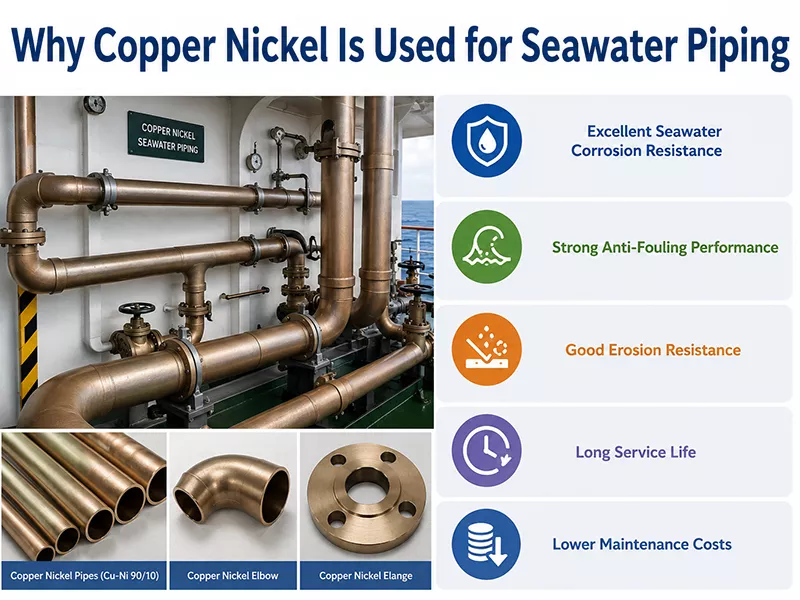
For shipbuilders, offshore engineers, desalination plants, and coastal industrial facilities, copper nickel is not just a material choice. It is a way to reduce maintenance risk, extend service life, and improve the overall safety of seawater piping systems.
If you need copper nickel pipes, fittings, or flanges for a marine project, view our copper nickel product range or contact our team for material selection support.
What Is Copper Nickel?
Copper nickel is an alloy made mainly of copper with nickel as the major alloying element. Small amounts of iron and manganese are often added to improve strength and corrosion resistance in flowing seawater.
The two most common grades used in seawater piping are:
- CuNi 90/10: About 90% copper and 10% nickel
- CuNi 70/30: About 70% copper and 30% nickel
CuNi 90/10 is widely used in shipbuilding, seawater cooling systems, and general marine service. CuNi 70/30 provides higher strength and better resistance in more demanding seawater conditions. You can compare both materials in more detail in our guide to CuNi 90/10 vs CuNi 70/30.
Excellent Resistance to Seawater Corrosion
The main reason copper nickel is used for seawater piping is its outstanding corrosion resistance.
When copper nickel is exposed to clean seawater, it naturally forms a thin protective oxide film on the surface. This film acts as a barrier between the metal and the seawater, helping to slow down corrosion and protect the pipe over long periods of service.
Unlike carbon steel, which can rust rapidly in seawater, copper nickel maintains stable performance without needing heavy coatings or complex corrosion protection systems. This is especially important in:
- Ship seawater cooling lines
- Ballast and bilge systems
- Offshore firewater systems
- Desalination intake and discharge lines
- Heat exchanger and condenser tubing
For systems built to international marine standards, ASTM B466 copper nickel tubes are commonly specified because of their proven performance in seawater applications.
Strong Protection Against Pitting and Crevice Corrosion
Chloride-rich environments can cause severe pitting and crevice corrosion in many stainless steels and other alloys. Pitting is especially dangerous because it can create deep, localized damage while the rest of the pipe surface appears normal.
Copper nickel performs well in seawater because it has strong resistance to localized corrosion. In properly designed systems with suitable flow conditions, copper nickel piping can operate for many years with minimal risk of pitting failure.
This makes it suitable for complex marine piping networks where joints, bends, valves, and fittings are exposed to continuous seawater contact. For complete systems, engineers often combine pipes with matching copper nickel fittings and copper nickel flanges to maintain consistent corrosion resistance across the entire line.
Natural Anti-Fouling Properties
Marine growth is a serious problem in seawater piping. Barnacles, algae, mussels, and other organisms can attach to internal pipe surfaces, reducing flow efficiency and increasing maintenance work.
Copper nickel has a natural resistance to biofouling. The copper content in the alloy helps discourage marine organisms from settling and growing on the surface. As a result, copper nickel seawater piping often stays cleaner than many alternative materials.
This provides several practical benefits:
- More stable flow rates
- Reduced pressure loss
- Less frequent cleaning
- Lower maintenance downtime
- Better heat transfer efficiency in cooling systems
For ships and offshore facilities, reduced biofouling means fewer operational interruptions and more predictable system performance.
Good Erosion-Corrosion Resistance in Flowing Seawater
Seawater piping is not only exposed to corrosion; it also deals with continuous flow, turbulence, and sometimes suspended sand or particles. If the pipe material is not strong enough, flowing seawater can gradually damage the protective surface layer and accelerate metal loss.
Copper nickel has good erosion-corrosion resistance when the system is properly designed. This is one reason it is widely used in seawater cooling and firewater systems, where flow velocity can vary depending on operating conditions.
However, flow velocity still matters. Excessively high velocity, sharp bends, poor welding, or trapped air can affect service life.
Long Service Life in Marine Environments
Copper nickel piping is often chosen because it offers a long service life with fewer maintenance requirements. In many seawater systems, the initial material cost is not the only concern. Operators also need to consider:
- Replacement cost
- Shutdown cost
- Inspection frequency
- Cleaning requirements
- Risk of leakage or failure
- Labor and installation cost
Although copper nickel may cost more upfront than carbon steel or some plastic piping options, it can provide better long-term value because it reduces the need for coating, chemical treatment, and frequent replacement.
For vessels, offshore platforms, and coastal industrial plants, this lifecycle advantage is one of the strongest reasons to choose copper nickel for seawater piping.
Reliable Performance in Shipbuilding and Offshore Systems
Copper nickel has been used in marine engineering for decades. Its performance is well understood, and it is accepted by many classification societies and international standards.
Common applications include:
- Seawater cooling systems
- Firewater piping
- Ballast systems
- Bilge lines
- Sanitary seawater systems
- Hydraulic and pneumatic lines in marine environments
- Offshore platform utility piping
- Desalination plant piping
- Heat exchanger and condenser systems
Because copper nickel is easy to fabricate, weld, and install, it is suitable for both new ship construction and retrofit projects. Many shipyards prefer it because it combines corrosion resistance with practical workability.
If your project requires complete material supply, you can explore our range of copper nickel pipe systems for marine and offshore applications.
Better Thermal Conductivity Than Many Stainless Steels
In seawater cooling systems, heat transfer is a key performance factor. Copper-based alloys generally offer better thermal conductivity than many stainless steels. This makes copper nickel a good material for heat exchangers, condensers, and seawater cooling lines.
Good thermal conductivity helps improve energy efficiency and system performance. In marine engines, power plants, and desalination equipment, this can make a noticeable difference over long operating periods.
Easy Fabrication, Welding, and Installation
Another advantage of copper nickel is its good fabrication performance. It can be cut, bent, formed, welded, and joined using standard industrial methods. This is important for shipyards and offshore projects where piping routes are often complex and space is limited.
Copper nickel also does not require extensive post-weld heat treatment in many typical applications, which helps simplify installation. With proper welding procedures and compatible filler metals, copper nickel piping systems can achieve strong and corrosion-resistant joints.
For best results, the entire system should use compatible materials, including pipes, elbows, tees, reducers, flanges, and valves.
Lower Maintenance Compared with Coated Steel
Carbon steel can be used in seawater systems, but it normally requires protective coatings, linings, cathodic protection, or chemical treatment. Once the coating is damaged, corrosion can spread quickly.
Copper nickel does not depend on an external coating for its main corrosion resistance. Its protective film forms naturally in seawater, making it more reliable in areas where coating damage is difficult to inspect or repair.
This is especially useful in:
- Engine rooms
- Offshore modules
- Confined piping spaces
- Underground or hard-to-access seawater lines
- Long-term marine service installations
Less dependence on coating means fewer maintenance tasks and a lower chance of hidden corrosion problems.
Need Copper Nickel Piping for a Marine Project?
Explore our copper nickel product range, including pipes, fittings, flanges, and tube solutions for seawater piping, shipbuilding, offshore platforms, desalination plants, and heat exchanger systems.
Ask Engineer copper nickel product rangeCuNi 90/10 or CuNi 70/30: Which One Is Better for Seawater Piping?
Both CuNi 90/10 and CuNi 70/30 are used in seawater piping, but the right choice depends on the operating environment.
CuNi 90/10
CuNi 90/10 is the most common grade for general seawater piping. It offers good corrosion resistance, excellent anti-fouling properties, and cost-effective performance.
Typical uses include:
- Ship seawater systems
- Cooling water lines
- Firewater systems
- Ballast piping
- General marine pipework
CuNi 70/30
CuNi 70/30 contains more nickel, which gives it higher strength and better resistance in more severe seawater conditions.
Typical uses include:
- High-velocity seawater systems
- Offshore platforms
- Severe marine environments
- High-performance heat exchangers
- Critical seawater service lines
For many standard marine applications, CuNi 90/10 is sufficient. For more demanding environments, CuNi 70/30 may be the better choice.
Copper Nickel vs Stainless Steel for Seawater Piping
Stainless steel is strong and widely used in many industries, but seawater can be challenging for some stainless grades. Chlorides can cause pitting, crevice corrosion, and stress corrosion cracking, especially in warm seawater or stagnant conditions.
Copper nickel, on the other hand, is specifically valued for seawater service. It resists biofouling, handles flowing seawater well, and does not rely heavily on coatings.
In many seawater piping systems, copper nickel offers a better balance of corrosion resistance, maintainability, and long-term cost.
Copper Nickel vs Carbon Steel for Seawater Piping
Carbon steel is cheaper at the initial purchase stage, but it is highly vulnerable to seawater corrosion unless properly protected. Coatings and linings can help, but they add cost and require regular inspection.
Copper nickel usually has a higher upfront cost, but it can reduce maintenance and replacement expenses over the life of the system. For critical marine systems, this reliability is often more valuable than the lower initial price of carbon steel.
Key Benefits of Copper Nickel Seawater Piping
Copper nickel is preferred for seawater piping because it provides:
- Excellent seawater corrosion resistance
- Strong resistance to pitting and crevice corrosion
- Natural anti-fouling performance
- Good erosion-corrosion resistance
- Long service life
- Lower maintenance requirements
- Good thermal conductivity
- Reliable welding and fabrication
- Proven performance in marine and offshore industries
These advantages explain why copper nickel remains one of the most trusted materials for seawater piping systems.
FAQs About Copper Nickel Seawater Piping
Why is copper nickel good for seawater piping?
Copper nickel is good for seawater piping because it resists seawater corrosion, pitting, erosion, and marine biofouling. It also offers a long service life and reduces maintenance compared to many alternative materials.
What is the best copper nickel grade for seawater?
CuNi 90/10 is commonly used for general seawater piping systems, while CuNi 70/30 is preferred for more severe conditions, higher strength requirements, and demanding offshore environments.
Does copper nickel rust in seawater?
Copper nickel does not rust like carbon steel. Instead, it naturally forms a stable protective surface film in seawater, which helps resist corrosion and significantly extends its service life.
Is copper nickel better than stainless steel for seawater?
In many seawater applications, copper nickel performs better than standard stainless steels due to its superior resistance to biofouling and localized chloride corrosion.
Where is copper nickel piping used?
Copper nickel piping is widely used in shipbuilding, offshore platforms, desalination plants, seawater cooling systems, firewater systems, ballast water lines, heat exchangers, and coastal power stations.